
Go Mod, Buddha Baby
“But when leading Buddhist figures, along with a mass of laity and sympathizers, begin to embrace a novel interpretation, practice, or idea, it should alert the scholar than an important reconstruction of doctrine is underway and that a new normativity could be emerging. . . The history of religions is precisely the history of such reconstitutions of doctrine and practice, which are themselves reconstitutions of prior versions.” (David McMahan, The Making of Buddhist Modernism, 2008, p. 180.)
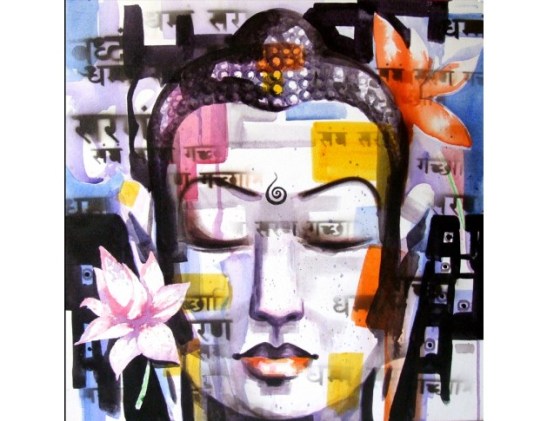 I’ve been reading David McMahan’s The Making of Buddhist Modernism, which I absolutely love. McMahan’s section on Buddhist Romanticism focused on Zen master D. T. Suzuki and his enormous influence on 20th century art, especially the Beats. He explains the 21st century reinvention of the Buddhist concept of pratityasamutpada as interdependence, which today is one of the major doctrinal sources of Buddhist ethics and social justice. McMahan provides a thorough critique of Buddhist modernism, which is a product of colonialist scientific and cultural processes (Asian and Western). Nonetheless, I am ready to declare that I am an unapologetic modernist.
It would be easy to misread this book as criticizing modernist Buddhism for incorporating too many non-Buddhist elements and therefore being inauthentic. McMahan is much too sophisticated a scholar to fall into that: he acknowledges that Buddhist traditions, like other traditions, have always needed to keep re-creating themselves, “amalgamating elements of new cultures, jettisoning those no longer viable in a new context, and asking questions that previous incarnations of Buddhism could not possibly have asked.” .* * * * *Of course, when we turn to Asian Buddhism we see only what we are able to see: as always, who we are determines what we look for. Yet what we look for and what we need may be quite different, which points to the basic issue at stake for Buddhist modernism.*(“How Buddhist is Buddhist Modernism?” David Loy, Tricycle, Spring 2012.)
As usual, Meta-Buddhist Inquiry will meet at the Halifax Central Library on Spring Garden Rd., somewhere on the fourth floor. I will post the dates in early January.
The full quote that David Loy excerpted is the following, and we will use these questions for our discussions:
*What is a Buddhist? What is the boundary between Buddhism and non-Buddhsim? At what point is Buddhism so thoroughly modernized, westernized, detraditionalized, and adapted that it simply no longer can be considered Buddhism?
We can surely dispense with the myth of the pure original to which every adaptation must conform. If “true Buddhism” is only one that is unalloyed by novel cultural elements, no forms of Buddhism existing today qualify. To say that western Buddhisms must adhere rigidly to their Asian predecessors would still be arbitrary, since they, too, are hybrids embracing numerous cultural adaptations. Every extant form of Buddhism has been shaped and reconfigured by the great diversity of cultural and historical circumstances it has inhabited in its long and varied existence. Buddhist traditions—indeed all traditions—have constantly re-created themselves in response to unique historical and cultural conditions, amalgamating elements of new cultures, jettisoning those no longer viable in a new context, and asking questions that previous incarnations of Buddhism could not possibly have asked.
(D. McMahan, The Making of Buddhist Modernism, 2008, p. 254)

 Engage!
Recent Comments